Key Takeaways
- Most Vermont homes use between 8,000 and 12,000 kWh per year, though larger or all-electric homes may need more.
- Quick estimate: divide your annual kWh use by 1,200 to get the approximate kW system size your home needs.
- Most full-offset systems for Vermont homes use between 30 and 36 panels.
- Heat pumps and EVs are the biggest future-load changes to plan for – each can add several thousand kWh of annual electric use.
- Vermont’s net-metering credits are below retail rates, so systems are sized slightly larger than your annual use to fully offset your bill.
Every home and homeowner is different, which is why we design custom solar systems to meet the unique needs of each customer. To accurately determine the best size for your system, we consider several key factors, including your energy usage, site conditions, and future energy needs.
Keep reading to learn more about the process we use to ensure your system is built to maximize both your energy production and long-term savings.
Evaluate Your Energy Usage
During your initial site visit, your Solar Advisor will ask for a recent electric bill. This helps us calculate your total annual energy consumption and design a system that offsets as much of your usage as possible.
We calculate your annual energy usage by adding up 12 months of kWh usage.
Most homes in Vermont use between 8,000-12,000 kWh per year, though larger or all-electric homes may require more.
Measure Sun Exposure with Site Evaluation
Not all properties receive the same amount of sunlight, which directly impacts how much energy your system can produce.
Key factors include:
- South-facing roofs (ideal for maximum production)
- East- and west-facing roofs (still effective with slightly reduced output)
- Shading from trees or nearby structures
We utilize drones in combination with a design software program called Scanifly to capture precise, high-resolution site data, allowing us to build highly accurate 3D models of your roof and surroundings. This ensures our system designs and production estimates are based on real-world conditions, resulting in more reliable performance projections and a smoother installation process.
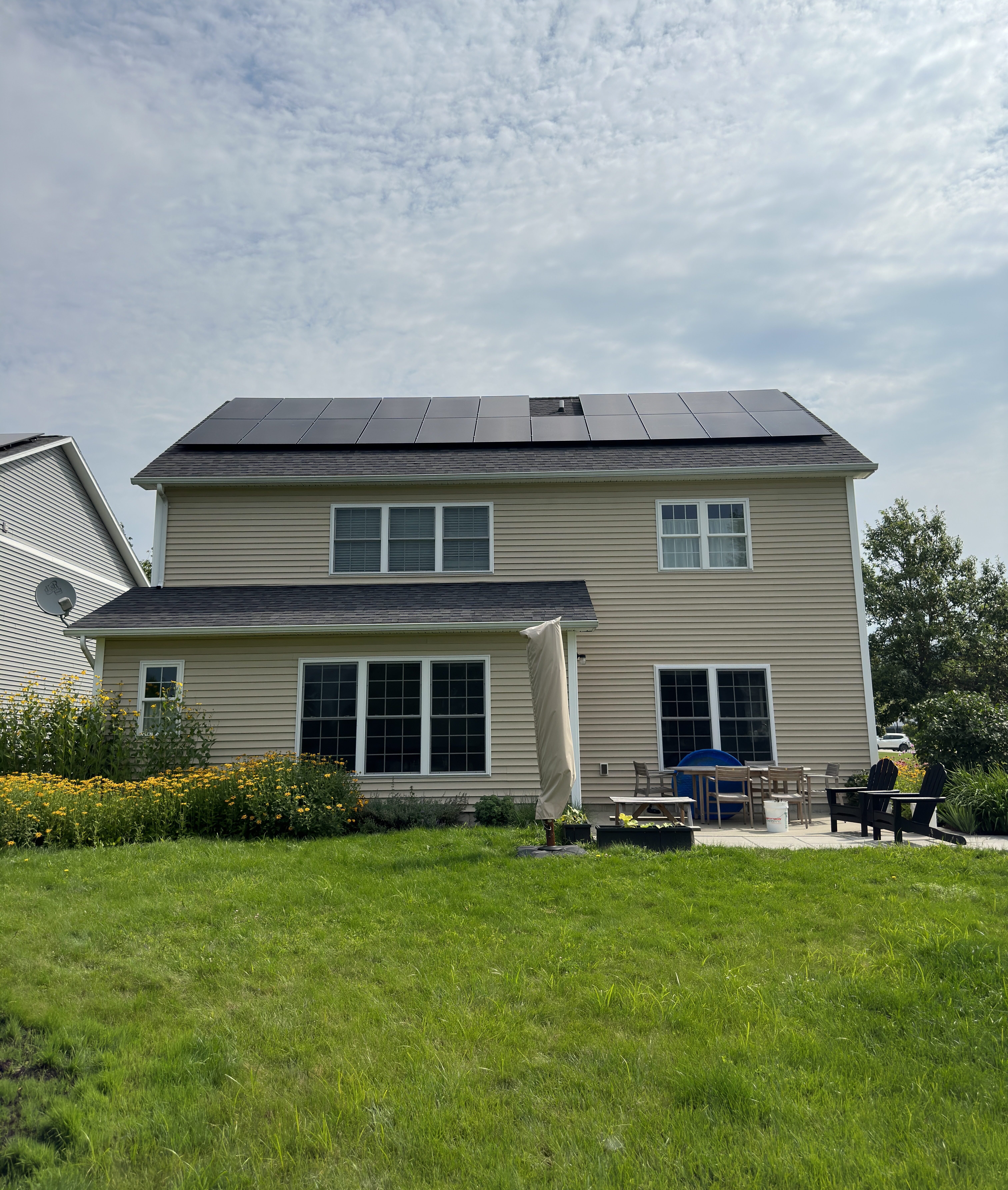
To offset the average annual energy usage of a Vermont home with solar, most systems require between 30 – 36 panels.
Plan for Future Energy Needs
Your energy use today might change over time. If you’re considering upgrades like heat pumps, electric vehicles, or new appliances, your electricity usage will likely increase. We factor these plans into your system design so it continues to meet your needs long-term, without requiring costly upgrades later.
How much can these additions change your annual use? A cold-climate heat pump replacing oil or propane typically draws 3,000 to 5,000 kWh per year. A single EV driven about 12,000 miles per year adds roughly 3,000 to 4,000 kWh. A heat pump water heater can add another 1,500 to 2,500 kWh. Sizing for those loads up front is almost always cheaper per watt than coming back to add panels later.
Factor in Vermont’s Net Metering Tariff
Because of Vermont’s net metering tariff, the credit you receive for excess solar generation is lower than the retail rate you pay for electricity. To ensure your solar system fully offsets your annual kWh energy costs we need to slightly oversize the solar system so that the total value of the credits offsets your usage over time.
Frequently Asked Questions
How many solar panels does a typical Vermont home need?
Most Vermont homes need 30 to 36 panels for a full offset, though the count depends on your annual kWh use, the panel wattage, and your roof’s sun exposure. A heat-pump or all-electric home can push past 40 panels.
Will a heat pump change the size of my solar system?
Yes. A cold-climate heat pump replacing oil or propane heat typically adds 3,000 to 5,000 kWh to your annual electric use. If you’re installing solar before adding the heat pump, plan for that load up front rather than expanding the system later.
What if I have an EV or plan to get one?
A single EV driven about 12,000 miles per year adds roughly 3,000 to 4,000 kWh to your annual electric use. Two EVs roughly double that. Sizing for the load now is cheaper than expanding the system after installation.
Can I add panels to an existing solar system later?
You can, but it’s more expensive per watt than building the right size from the start. A retrofit means a new permit, possibly new inverter capacity, and another interconnection application with your utility.
What if my roof can’t fit the system size I need?
Two options. A ground-mount system clears that limit if you have the yard space. Otherwise, we size to the roof’s maximum and design the system to offset as much of your usage as your roof can physically support.
How accurate are GMS production estimates?
Our estimates are based on Scanifly 3D site modeling and verified against actual production data from past Vermont installs. Real-world output typically lands close to the design estimate after the first full calendar year.
Ready to Find Your Perfect System Size?
A complimentary site evaluation with one of our Solar Advisors allows us to give you customized recommendations for your home based on your home, your goals, and your energy use. With the right system design, you can confidently make the switch to solar and lower your carbon footprint and your monthly bills.